



Healthcare Analytics Solutions for Successful Outcomes
The way healthcare organizations make decisions is fundamentally changing. We’re moving away from relying on gut feelings and toward strategies built on a solid foundation of data. In this new reality, healthcare analytics solutions aren’t just a “nice-to-have”; they’re absolutely essential for any modern medical organization that wants to succeed.
This guide is your roadmap, designed to walk you through everything from the basic concepts to the sophisticated applications of AI.
From Guesswork to Data-Driven Decisions in Healthcare
Let’s be honest: the healthcare industry is under enormous pressure. Costs are climbing, patient needs are getting more complex, and the regulatory environment is a minefield. The old way of doing things, based mostly on experience and intuition, just can’t keep up anymore. This is precisely where analytics steps in, offering a way to find new efficiencies and, most importantly, improve patient outcomes.
Healthcare organizations are sitting on a mountain of data from electronic health records (EHRs), medical scans, patient wearables, and billing systems. By tapping into this data, you can uncover insights that were previously invisible, completely reshaping how care is delivered.
The Growing Demand for Healthcare Analytics
This shift toward data-driven decisions isn’t just a passing trend; it’s a massive market movement. The global healthcare analytics market is on a steep upward trajectory, expected to jump from USD 55.52 billion in 2025 to an incredible USD 166.65 billion by 2030.
That explosive growth, a compound annual growth rate (CAGR) of 24.6%, tells a clear story. Organizations everywhere are realizing they need data to get a handle on costs and elevate the quality of care. We saw this in action during the COVID-19 pandemic, where analytics helped some health systems allocate resources so quickly that they cut response times by up to 30%. You can read the full report on the healthcare analytics market expansion to learn more.
This growth is a clear signal that data is now seen as a critical asset. But navigating this complex data landscape is tough, and it often requires a dedicated technology partner. An expert AI solutions partner can guide healthcare providers in building and implementing the robust systems needed to turn all that raw data into meaningful, actionable intelligence.
Key Takeaway: Moving to data-driven healthcare is more than just plugging in new software. It’s a strategic pivot where every decision, from a clinical diagnosis to an operational workflow, is backed by solid data analysis.
This strategic shift is at the heart of what many are calling the next wave of healthcare innovation. As we’ve discussed in our guide on accelerating healthcare digital transformation, adopting technology is the first step. Analytics is the engine that actually drives that transformation forward, empowering organizations to:
-
Improve Patient Outcomes: Pinpoint at-risk populations and intervene with proactive, personalized care.
-
Boost Operational Efficiency: Optimize how staff and equipment are used, streamline administrative backlogs, and cut down on waste.
-
Enhance Financial Performance: Tighten up revenue cycle management and stay on top of regulatory compliance.
Understanding The Three Levels Of Healthcare Analytics
If you’re going to get started with healthcare analytics, the first thing to know is that it’s not all one thing. Analytics exists on a spectrum of sophistication, with each level offering deeper insights than the last. Think of it as a journey from simply looking in the rearview mirror to having a GPS that not only predicts traffic but also gives you the best detour.
This journey is all about moving from gut-feel decisions to ones backed by solid data, ultimately leading to better care and a healthier bottom line.
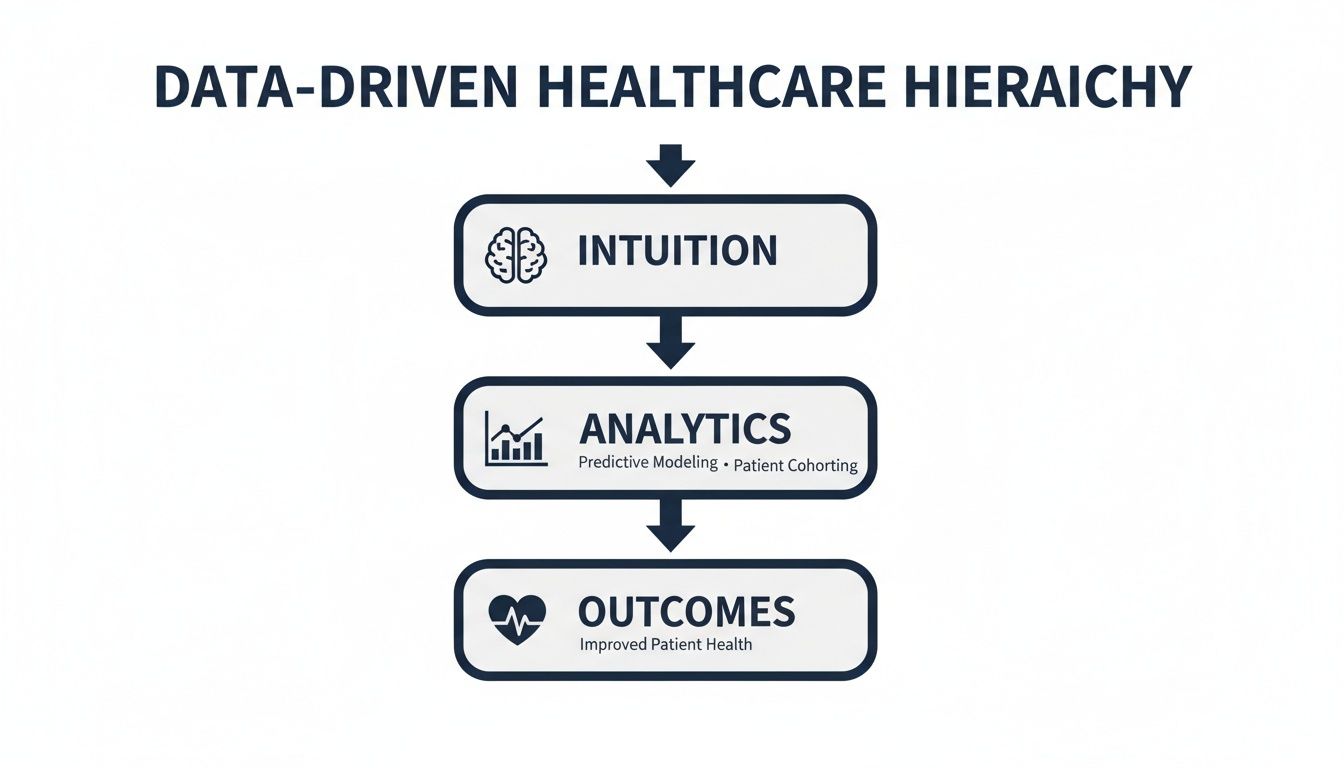
The image above really captures this shift. It’s about building a structured, data-informed culture that can systematically improve how you operate and how you treat patients. The aim is to get beyond basic reports and into a world where data actively shapes your strategy.
To make sense of this, let’s break down the three core types of analytics. Each answers a different question and provides a unique kind of value.
The Three Levels of Healthcare Analytics
| Analytics Type | Core Question | Example Application | Business Value |
|---|---|---|---|
| Descriptive | What has happened? | A dashboard showing monthly patient admission rates and average length of stay. | Establishes a baseline for performance, identifies historical trends, and highlights operational inefficiencies. |
| Predictive | What is likely to happen next? | An algorithm that flags patients at high risk for 30-day hospital readmission based on their clinical history. | Enables proactive interventions, reduces preventable adverse events, and improves resource allocation. |
| Prescriptive | What should we do about it? | A system that recommends the optimal staffing schedule for the ER based on predicted patient inflow. | Provides real-time, data-backed recommendations to guide decisions, optimize outcomes, and enhance efficiency. |
Understanding these distinctions is key because each level builds on the one before it. You can’t predict the future if you don’t understand the past.
H3: Descriptive Analytics: The Foundational View
Descriptive analytics is your starting point – your ground truth. It answers the most fundamental question: “What has happened?” Like an EKG reading shows a patient’s recent heart activity, descriptive analytics gives you a clear picture of past performance by summarizing historical data.
This is all about creating a baseline. For instance, a hospital administrator might use it to:
-
Track patient wait times in the emergency department over the last quarter.
-
Monitor the rate of hospital-acquired infections (HAIs).
-
Analyze claim denial rates by insurer.
This foundational layer is the most common for good reason; it’s accessible and delivers immediate value. In fact, descriptive analytics is expected to hold a dominant 34.5% market share in 2025, proving it’s the bedrock of most healthcare data strategies. It allows you to get your arms around what’s actually happening without needing a team of data scientists from day one. You can learn more from these healthcare analytics market findings.
H3: Predictive Analytics: Forecasting Future Events
Once you have a solid grasp of your past performance, the natural next question is: “What is likely to happen next?” This is where predictive analytics comes in. It uses historical data, statistical models, and machine learning to forecast future outcomes.
Predictive analytics is the shift from being reactive to proactive. Instead of just identifying problems after they occur, you can start anticipating and preventing them. This is where you truly start to see a powerful return on your data investment.
In a clinical setting, a predictive model might identify which patients are at high risk for developing sepsis or being readmitted within 30 days. Armed with that knowledge, care teams can intervene before a crisis hits; perhaps with targeted follow-up calls or a home health visit. Building the platforms to run these complex models often requires a strong custom software development partner who understands the nuances of healthcare data.
H3: Prescriptive Analytics: Recommending Optimal Actions
The final frontier of analytics is prescriptive. This is the most advanced level, and it answers the ultimate question: “What should we do about it?” If predictive analytics is the warning light on your dashboard, prescriptive analytics is the onboard computer telling you exactly which service station to go to and what to have the mechanic check first.
It takes things a giant leap further by recommending specific actions to get the best possible result. It synthesizes predictive models with operational rules and optimization algorithms to guide decision-making in the moment.
For example, a prescriptive tool could analyze a patient’s genetic markers, lifestyle, and clinical data to recommend a highly personalized cancer treatment plan. On the operational side, it might optimize OR scheduling in real-time to maximize throughput and reduce staff burnout. This is the goal: turning raw data into concrete, actionable steps that directly improve both patient care and the bottom line.
Where the Rubber Meets the Road: How Analytics is Changing Patient Care
Enough with the theory. Let’s talk about what happens when healthcare analytics gets out of the spreadsheet and into the clinic. This is where the real magic happens, transforming how we care for patients and manage the health of our communities. The true value isn’t in the data itself, but in the stories of real-world change.
These examples aren’t just hypotheticals; they show how analytics acts as a catalyst, completely reshaping how care is delivered. Every success story, much like the ones we’ve detailed in our client cases, is built on a solid foundation of smart technology and a deep understanding of healthcare’s unique challenges.

Population Health Management
In the past, spotting at-risk communities was a guessing game based on old data, like last quarter’s hospital admission rates. Public health programs would cast a wide net, hoping to reach the people who needed help the most. It was inefficient and, frankly, often too late to make a real difference.
Today, population health management tools flip that script. Health systems can now look ahead, spotting high-risk groups before a crisis hits. By blending data from EHRs, insurance claims, and even public socioeconomic information, predictive models can light up a map, showing exactly which neighborhoods are struggling with high rates of diabetes or heart disease.
This clarity allows organizations to get specific:
-
Send mobile clinics, or host targeted health workshops right where they’re needed.
-
Pinpoint individuals who are overdue for critical preventative care, like mammograms or vaccinations.
-
Funnel resources to the communities that will benefit the most, instead of spreading them thin.
The result? We move from just treating sick people to actively keeping communities healthy, which reduces the burden of chronic disease and brings down long-term costs.
Key Insight: Population health analytics is a fundamental shift. It moves us from playing defense, treating illnesses one by one, to playing offense by managing the health of an entire community and stopping disease in its tracks.
Clinical Decision Support
Picture this: a doctor is in an exam room, juggling a patient’s complex history while trying to remember the latest treatment protocols. Before analytics, this all came down to memory and frantic chart-flipping. It was a recipe for missed details and potential errors.
Clinical Decision Support (CDS) systems change everything. Think of a CDS as an intelligent co-pilot built right into the clinical workflow. It quietly analyzes data in the background and offers up crucial, data-backed insights right when the doctor needs them most.
For example, a CDS tool might:
-
Flash a warning about a potential drug interaction before a prescription is sent.
-
Alert a physician that a patient’s latest lab results are ticking toward sepsis.
-
Suggest the most effective, evidence-based treatment path for a patient’s specific diagnosis.
This isn’t about replacing a clinician’s judgment; it’s about augmenting it. Giving them instant access to synthesized data helps them make faster, safer, and more accurate decisions. Building these seamless tools requires specialized healthcare software development that marries clinical needs with a robust data architecture.
Revenue Cycle Optimization
The financial side of healthcare is a tangled web of codes, claims, and denials. For years, hospitals wrestled with high denial rates, painfully slow payment cycles, and revenue slipping through the cracks. Finding the source of the problem was like searching for a needle in a haystack of paperwork.
Analytics brings a spotlight to the chaos of revenue cycle management (RCM). By crunching historical claims data, RCM platforms can spot the patterns that lead to denials, whether it’s a common coding mistake or consistently missing paperwork from a specific department. Some systems can even predict which claims are likely to be rejected before they’re ever submitted.
This data-driven focus lets finance teams:
-
Slash claim denial rates, in some cases by up to 40%, by fixing problems proactively.
-
Speed up the billing cycle by automating repetitive tasks and pointing staff to the most important follow-ups.
-
Walk into negotiations with payers armed with hard data on reimbursement trends.
Ultimately, this creates a much healthier financial footing for the entire organization, freeing up resources to reinvest in what really matters: patient care. The most powerful platforms here often rely on sophisticated AI development services to drive their predictive capabilities, showing a direct line from data intelligence to financial stability.
FAQs About Healthcare Analytics Use Cases
1. How does analytics help in managing chronic diseases?
It helps identify at-risk patients early, monitor their progress through data from remote devices, and even predict potential complications before they happen. This allows care teams to step in proactively, preventing costly emergency visits and improving a patient’s day-to-day life.
2. Can small clinics or private practices benefit from these solutions?
Absolutely. You don’t need to be a massive hospital system to see the benefits. Affordable, cloud-based analytics tools can help smaller practices optimize their schedules, clean up their billing, and track patient outcomes to prove their quality of care to insurance payers.
3. What is the role of patient-generated data in healthcare analytics?
It’s becoming huge. Data from wearables, health apps, and patient portals gives clinicians a view into a patient’s life outside the exam room. This information is gold for creating personalized care plans and monitoring chronic conditions like high blood pressure or diabetes in near real-time.
Building a Secure and Compliant Data Framework
To get any real value out of healthcare analytics, you have to start with a foundation of trust. That trust isn’t just about good intentions; it’s built on a technical framework that’s secure, compliant, and strong enough to protect incredibly sensitive patient data. If you skip this step, even the most brilliant analytics program is built on sand.
First, you have to decide where your data will live. The two most common models are the data warehouse and the data lake. Think of a data warehouse as a perfectly organized library. Data is cleaned, structured, and cataloged before it ever hits the shelves, which is perfect for running specific reports and powering business intelligence dashboards.
A data lake, on the other hand, is more like a massive reservoir. It holds huge volumes of raw, unstructured data just as it is: everything from a doctor’s handwritten notes to MRI files. This raw flexibility is exactly what data scientists need for deep, exploratory analysis and for training sophisticated machine learning models. In reality, most healthcare systems are now using a hybrid approach, getting the best of both worlds.
The Non-Negotiable Core of HIPAA Compliance
No matter which architecture you choose, compliance isn’t just a feature; it’s the law. The Health Insurance Portability and Accountability Act (HIPAA) is the bedrock of patient data protection. Following its rules has to be at the core of your entire data strategy.
Getting HIPAA right really comes down to three critical pillars:
-
Strong Data Governance: This is your rulebook. It clearly defines who can access what data, when, and why. Without clear governance, you’re inviting unauthorized access and unethical data use.
-
Immutable Audit Trails: Every single time someone touches Protected Health Information (PHI), it needs to be logged. You must have a detailed, unchangeable record showing who accessed the data, what they saw, and when. These trails are absolutely essential for security audits and investigating potential breaches.
-
Strict Access Controls: A billing specialist doesn’t need access to clinical trial data. Role-based access controls (RBAC) are fundamental. They ensure that people can only see the specific information they need to do their jobs, which dramatically shrinks your risk of exposure.
Building these safeguards into your systems from the very beginning is a complex task. For a closer look at the development process, our guide on creating HIPAA-compliant applications is a great resource.
Using the Cloud for a Scalable and Secure Foundation
Trying to manage the sheer amount of infrastructure needed for modern healthcare analytics on-site is a massive headache. This is why so many organizations are turning to cloud platforms like Amazon Web Services (AWS) and Microsoft Azure. They offer entire suites of services that are already designed to handle sensitive data in HIPAA-eligible environments.
The real beauty of the cloud is its elasticity. You can spin up enormous computing power for a complex research project and then scale right back down when you’re done, all without having to buy and maintain racks of expensive servers. You also get the benefit of their world-class, full-time security teams.
This focus on a secure financial footing is more important than ever. The financial side of healthcare analytics is growing at a staggering 18.20% CAGR, largely because of the immense pressure to get costs under control. With U.S. healthcare spending hitting $4.5 trillion in 2022, analytics is one of the few tools that can meaningfully optimize revenue cycles and claims. Predictive models can flag improper payments before they go out the door, potentially saving an organization 5-10% on claims denials.
A compliant framework has to cover the entire lifecycle of data, from the moment it’s created to the day it’s securely destroyed. This even includes physical hardware. For healthcare organizations, that means using specialized services like HIPAA-compliant electronics recycling for healthcare providers to ensure old devices don’t become a data breach waiting to happen.
Taking Analytics to the Next Level with AI and Machine Learning
If traditional analytics is like looking in the rearview mirror, adding Artificial Intelligence (AI) and Machine Learning (ML) is like turning on a highly sophisticated GPS for the road ahead. It’s the critical shift from simply reporting on what has happened to accurately predicting what will happen.
By layering AI onto your healthcare analytics solutions, you move beyond historical reports and start anticipating future events. This is what allows care to become truly proactive, not just reactive. It’s here that the real promise of predictive and prescriptive analytics shines, forecasting patient outcomes and optimizing hospital workflows with a precision we could only dream of a decade ago.

Finding New Clinical and Operational Insights
AI and ML are brilliant at turning massive, complex datasets into clear, actionable intelligence. For healthcare providers, this opens up some powerful new avenues for improving both efficiency and patient-centric care.
Here’s a look at what this means in practice:
-
Predictive Disease Modeling: Think of AI algorithms that can sift through thousands of data points: EHRs, lab results, even genetics, to flag patients at high risk for sepsis, diabetes, or heart failure. This gives clinical teams a chance to step in early, long before a condition becomes critical.
-
Natural Language Processing (NLP): An incredible 80% of healthcare data is unstructured, buried in things like physicians’ notes, dictated reports, and patient emails. NLP is the key that unlocks this data, extracting insights that can reveal gaps in care or spot adverse drug reactions.
-
Medical Image Analysis: Computer vision models can analyze X-rays, CT scans, and MRIs to spot abnormalities like tumors or fractures with stunning accuracy. They don’t replace radiologists, but they act as a tireless second set of eyes, flagging potential issues and helping prioritize the most urgent cases.
To see how this works on the ground, consider how AI in healthcare is already supporting teams through tools like chatbots that handle patient communication and initial triage. It’s a great example of offloading administrative work so skilled staff can focus on high-value clinical duties.
Navigating the Hurdles of AI Implementation
While the potential of AI is enormous, getting it right means having a clear-eyed view of the challenges. These aren’t showstoppers, but they are critical points that need to be addressed for any implementation to be successful and ethical.
One of the biggest hurdles is data bias. If an AI model is trained on data from one demographic, its predictions for other groups might be way off, potentially making health disparities worse. Building a diverse and representative training dataset is non-negotiable.
Another major challenge is the “black box” problem. Some of the most powerful ML models can reach a conclusion without being able to explain how they got there. In a clinical setting, where lives are on the line, that kind of opacity is a deal-breaker. The focus has to be on “explainable AI” (XAI), models that can justify their recommendations in plain language.
Key Takeaway: The real goal isn’t just to build powerful AI models, but to build trustworthy ones. Success hangs on tackling bias, ensuring transparency, and validating every step from the very beginning.
This is exactly why finding the right partner is so important. As we explored in our guide on the top AI trends transforming healthcare, an experienced guide can help you navigate these complexities. They know that a successful AI initiative is less about the algorithm and more about the strategy around it, from managing data quality to integrating the final tool into clinical workflows. An expert partner turns potential pitfalls into genuine opportunities for innovation and better care.
For more on this topic, see our related article: AI trends in healthcare.
Your Strategic Roadmap to Implementation
Jumping into a healthcare analytics project without a clear plan is like trying to perform surgery without a diagnosis. You need a thoughtful, phased strategy to make sure your investment actually pays off. This roadmap will help you turn ambitious goals into a concrete plan, guiding your team from the initial “what if” stage to a successful rollout and beyond.
A good strategy starts with a bit of self-reflection. Before you even think about looking at vendors or shiny new software, you need to get a handle on where you are now and, more importantly, where you want to go.
Phase 1: Define Your Goals and Assess Your Readiness
The first, most critical question is simple: “What problem are we trying to solve?” As we’ve seen in our guide on common data mistakes, starting with the data instead of the business need is a recipe for confusion and wasted effort.
Get specific about what you want to accomplish. Are you trying to:
-
Cut patient readmission rates by 15% in the next twelve months?
-
Speed up the average claim denial resolution time by 25%?
-
Get a much clearer picture of patient risk for chronic diseases?
With those goals in mind, take an honest look at your organization’s data maturity. Do you have clean, accessible data? Is there a basic data governance policy in place, or is it the wild west? Knowing your starting point helps you set realistic expectations and figure out what foundational work needs to be done first.
Phase 2: Select the Right Partner and Launch a Pilot
Once your goals are crystal clear, you can start looking for the right partner. Think of your vendor as more than just a software provider; they’re your guide on this journey. The best partners bring not only powerful technology but also deep, real-world healthcare expertise. Our client cases show just how much a collaborative approach can achieve.
When you’re vetting a potential AI solutions partner, make sure to ask the tough questions:
-
Do they have a proven track record in healthcare software development?
-
Can their platform securely plug into your existing EHR and other critical systems?
-
How, exactly, do they handle HIPAA compliance and data security?
After choosing a partner, don’t try to boil the ocean. Start with a focused pilot project. Pick a single, high-impact problem that lines up with one of your main goals. A successful pilot creates momentum, shows stakeholders a tangible return on investment, and teaches you valuable lessons for the full-scale rollout.
Phase 3: Measure Success and Scale Your Initiative
You absolutely have to define what success looks like from the very beginning. Your Key Performance Indicators (KPIs) are the yardsticks for measuring the real-world impact of your analytics solution. These should tie directly back to the goals you set in Phase 1, things like patient wait times, diagnostic accuracy, or operational costs.
Key Insight: Continuously tracking KPIs is how you prove value and make the case for future investment. It turns your analytics program from just another line item on a budget into a proven engine for improving both clinical and financial outcomes.
As your pilot project proves its worth, you can begin to scale. Expand the initiative to other departments and tackle new challenges. This phased approach, backed by a partner with expertise in custom software development and AI development services, is the key to sustainable growth. By implementing AI for your business in this thoughtful way, you build a more resilient, data-informed organization ready for whatever comes next.
Got Questions? We Have Answers
We’ve covered a lot of ground. Here are some quick answers to the questions we hear most often from organizations just like yours.
What’s the Real Goal of Healthcare Analytics?
At its core, healthcare analytics is about turning a mountain of raw data into a handful of smart decisions. Think about all the information you have: in EHRs, billing systems, and even patient wearables. The goal is to connect those dots to improve patient care, make your operations run smoother, and ultimately, lower costs. It’s about being able to answer not just “what happened?” but “why did it happen and what should we do next?”
How Exactly Does This Make Patients Safer?
This is where analytics truly shines. It helps you get ahead of problems before they become crises. For example, a predictive model can flag a patient who is at high risk for developing a hospital-acquired infection or having a bad reaction to a certain medication. That simple alert gives your clinical team a chance to step in before something goes wrong, preventing harm and improving outcomes.
Do I Need a PhD in Data Science to Use These Tools?
Absolutely not. While data scientists are the wizards who build and fine-tune the complex models behind the scenes, modern analytics platforms are built for the rest of us. They use intuitive dashboards and clear visualizations, so clinicians and administrators can easily explore the data, spot trends, and find answers without writing a single line of code.
We’re Interested. What’s the First Step?
Don’t try to boil the ocean. The best way to start is to pick one specific, nagging problem you want to solve. Maybe it’s reducing patient no-show rates or understanding why one department has longer wait times. Once you have a clear target, you can identify the data you need and launch a focused pilot project. Partnering with a specialist in healthcare software development can give you the roadmap and expertise to make that first project a win.
Where Does AI Fit into All This?
Think of AI as the engine that takes your analytics from rearview mirror to crystal ball. Standard analytics tells you what happened; AI helps you predict what will happen. As we covered in our guide on implementing AI for your business, machine learning can forecast disease outbreaks, optimize ER staffing for the next shift, or personalize patient treatment plans. That predictive power is what delivers the biggest breakthroughs.
Ready to turn your healthcare data into your most valuable asset? Bridge Global is your expert AI solutions partner. We specialize in custom software development and advanced AI development services that deliver real-world results. Let’s build a smarter, data-driven future for your organization together.

About Preethi Saro Philip
Preethi Saro Philip is a Post Graduate Research Degree holder in Economics with more than 10 years of experience in writing, editing, research and teaching. She has an intense passion for content crafting and calls herself a ‘wordsmith’. She enjoys writing on wide-ranging topics including business, technology, health & lifestyle, education, environment etc.
View all posts by Preethi Saro Philip →