



A Guide to Remote Patient Monitoring Solutions in Healthcare
Think about traditional healthcare. A patient with a chronic condition, like heart disease or diabetes, might see their doctor every few months. What happens in between those appointments? It’s a total black box.
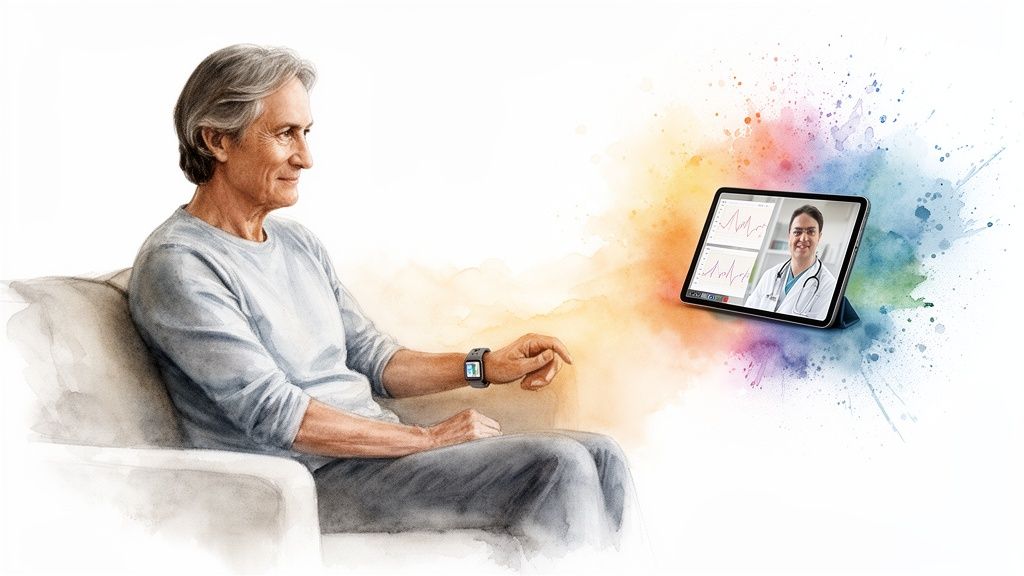
Remote patient monitoring (RPM) solutions are designed to light up that black box. Instead of relying on occasional snapshots from office visits, RPM provides a continuous video stream of a patient’s health, all from the comfort of their own home. It’s about using smart, connected devices to catch problems early, before they become emergencies.
The Next Generation of Patient Care
This isn’t just about convenience; it’s a fundamental change in how we manage long-term health. RPM allows clinical teams to move from being reactive, treating a crisis after it happens, to being proactive. They can see subtle changes in vital signs and step in with guidance or treatment adjustments right away.
The market is exploding for a reason. In the U.S. alone, the RPM market is on track to blow past $18 billion by 2026, growing at a blistering pace of nearly 25% year over year. A big driver is the sheer number of people, over 500 million globally, living with chronic conditions. New reimbursement codes have also made it a financially smart move for healthcare providers. You can read the full research about RPM market trends to get a sense of just how massive this shift is.
Core Components of Modern RPM
So, how does it all work? A modern RPM system is really an ecosystem of a few key parts working together. Getting these right is the first step to a successful program.
-
Wearable and Home-Use Devices: These are the frontline tools. Think smartwatches, connected blood pressure cuffs, digital glucose meters, or pulse oximeters. They’re what the patient actually interacts with to capture their health data every day.
-
Secure Data Transmission: That data has to get from the patient’s living room to the doctor’s screen without a hitch. This usually happens over Bluetooth or cellular networks, with rock-solid encryption to keep sensitive health information completely private.
-
Intelligent Clinical Platforms: This is mission control. It’s the software where clinicians log in to see trends, review alerts, and make decisions. A great platform doesn’t just dump raw numbers on the screen; it intelligently filters the data to show what truly needs attention.
Building a successful RPM program means connecting these components seamlessly. The true power lies not just in the devices but in creating an integrated ecosystem that turns raw data into clinical intelligence.
Putting all these pieces together: the hardware, the connectivity, the software, the security, is no small feat. It requires a solid grasp of both technology and the realities of healthcare. This is where an expert AI solutions partner can make all the difference, helping you design and roll out a system that’s effective, secure, and ready to grow with you.
How RPM Improves Outcomes and Efficiency
When you bring remote patient monitoring into your practice, it creates a powerful ripple effect. It’s not just about adding new technology; it’s about fundamentally changing the dynamic between patients and their care teams for the better. The impact is felt in two major ways: first, in the tangible clinical outcomes that help people live healthier lives, and second, in the operational efficiencies that make the entire healthcare system stronger.
For patients, this means care is no longer just something that happens during a scheduled appointment. It’s continuous and proactive, catching small issues before they become big problems. For providers, it’s about breaking free from the limitations of episodic, in-office visits. You gain a clearer, more consistent view of a patient’s health, which not only improves care but also unlocks real business advantages by using resources more effectively and cutting down on preventable, high-cost events.
Better Health Through Proactive Clinical Care
At the end of the day, the true test of any health technology is whether it makes patients healthier. This is where RPM really shines. By providing a steady stream of objective, real-world data, it gives clinical teams the insight they need to step in at just the right moment. This proactive model leads to measurable health improvements, especially for those managing chronic conditions.
Here’s where we see the biggest clinical wins:
-
Fewer Hospital Readmissions: For high-risk conditions like congestive heart failure, RPM is a game-changer. Simply by monitoring daily weight, blood pressure, and oxygen levels from home, providers can catch fluid retention early and adjust medications, helping to reduce readmissions by as much as 38%.
-
Tighter Chronic Disease Management: Think about a patient with diabetes. Instead of relying on a logbook brought to an appointment every three months, their care team can see daily glucose trends from a connected meter. This allows for near real-time adjustments to insulin or diet, leading to much better glycemic control.
-
Smoother Post-Surgical Recovery: After a patient goes home from a major surgery, RPM can keep a close watch on vital signs, pain levels, and even wound healing through patient-reported photos. This constant vigilance helps flag potential complications, like an infection, far earlier than a follow-up call might.
By essentially turning a patient’s home into a temporary care setting, RPM solutions close the dangerous gaps between office visits. This constant connection empowers clinicians to make smarter, data-driven decisions that directly lead to better health.
Driving Operational and Financial Strength
The clinical victories are compelling, but RPM also delivers serious operational and financial benefits. It helps healthcare organizations work smarter, manage large patient populations more effectively, and build a more stable financial footing. Tapping into specialized healthcare software development is key to building a system that unlocks these efficiencies and delivers a solid return on investment.
A well-designed RPM program doesn’t just add a new task; it streamlines existing workflows. It helps reallocate your team’s valuable time and attention to the patients who need it most, creating a more scalable and resilient model for delivering care.
A Clearer Look at the Impact
To really grasp the difference RPM makes, it helps to compare the old way of doing things with the new. Shifting from traditional, reactive care to a proactive, RPM-enabled model changes everything from staff workload to long-term cost management. This table breaks down that transformation.
Impact of RPM Implementation on Healthcare Delivery
| Metric | Traditional Care Model | With Remote Patient Monitoring Solutions |
|---|---|---|
| Patient Data Collection | Manual, episodic data gathered only during in-person visits. | Automated, continuous data collected daily from the patient’s home. |
| Clinical Intervention | Reactive, often occurring after a patient reports a significant symptom or crisis. | Proactive, with interventions triggered by subtle data trends before a crisis develops. |
| Staff Workload | High volume of routine check-up calls and manual data entry. | Focused on managing exceptions and engaging with at-risk patients identified by the system. |
| Care Scalability | Limited, as one clinician can only manage a small number of high-risk patients effectively. | High, allowing a single clinician to oversee a much larger patient panel efficiently. |
| Healthcare Costs | Higher long-term costs due to preventable emergency room visits and hospitalizations. | Lower long-term costs driven by early intervention and reduced need for acute care. |
As you can see, the move to RPM isn’t just an upgrade; it’s a complete operational overhaul. It shifts the focus from reacting to crises to preventing them, which ultimately benefits everyone involved.
Understanding the Technology Behind RPM
To really get a feel for how remote patient monitoring solutions work, it’s worth taking a look under the hood. The best way to think about an RPM system isn’t as a single piece of tech, but more like a four-part relay race. The baton is the patient’s health data, and it’s passed securely and instantly from their home right to the clinician.
Every stage in this race is absolutely critical. If one part falters, the whole system breaks down. Let’s break down these four essential layers, starting right where the journey begins: with the patient.
Layer 1: Patient-Side Devices
This is the part of the system you can actually touch and feel – the physical devices patients use every day. These aren’t just cool gadgets; they’re medical-grade instruments built to be both accurate and simple to use. They capture the vital signs that paint a clear picture of a patient’s health between office visits.
A few common examples include:
-
Smart Blood Pressure Cuffs that take a reading and automatically send it off.
-
Digital Glucometers for keeping a close eye on blood sugar.
-
Pulse Oximeters to check blood oxygen levels, a key metric for respiratory conditions.
-
Connected Weight Scales that track small changes that might signal bigger issues like fluid retention in heart failure patients.
-
Wearable ECG Monitors, like the ones in many smartwatches, which can catch irregular heart rhythms.
For anyone curious about the nitty-gritty of how these wearables work, a cardiologist’s guide to the smartwatch ECG offers a fantastic deep dive. These devices are the starting line, where all the valuable data is generated.
Layer 2: Secure Connectivity
Once a device takes a reading, that information has to get from the patient’s living room to a secure server. That’s the job of the connectivity layer. Think of it as a digital armored truck, protecting sensitive health data on its journey.
This is typically handled using common, secure protocols like Bluetooth Low Energy (BLE). The device syncs with a patient’s smartphone or a small, dedicated hub in their home. From there, the data is encrypted and sent over the internet.
This secure bridge is non-negotiable; it’s what ensures patient privacy is locked down tight. As we explored in our guide, the principles of secure data transfer are foundational to the Internet of Things (IoT).
This diagram gives a great visual breakdown of how the technology directly fuels both better clinical outcomes and smoother operations.
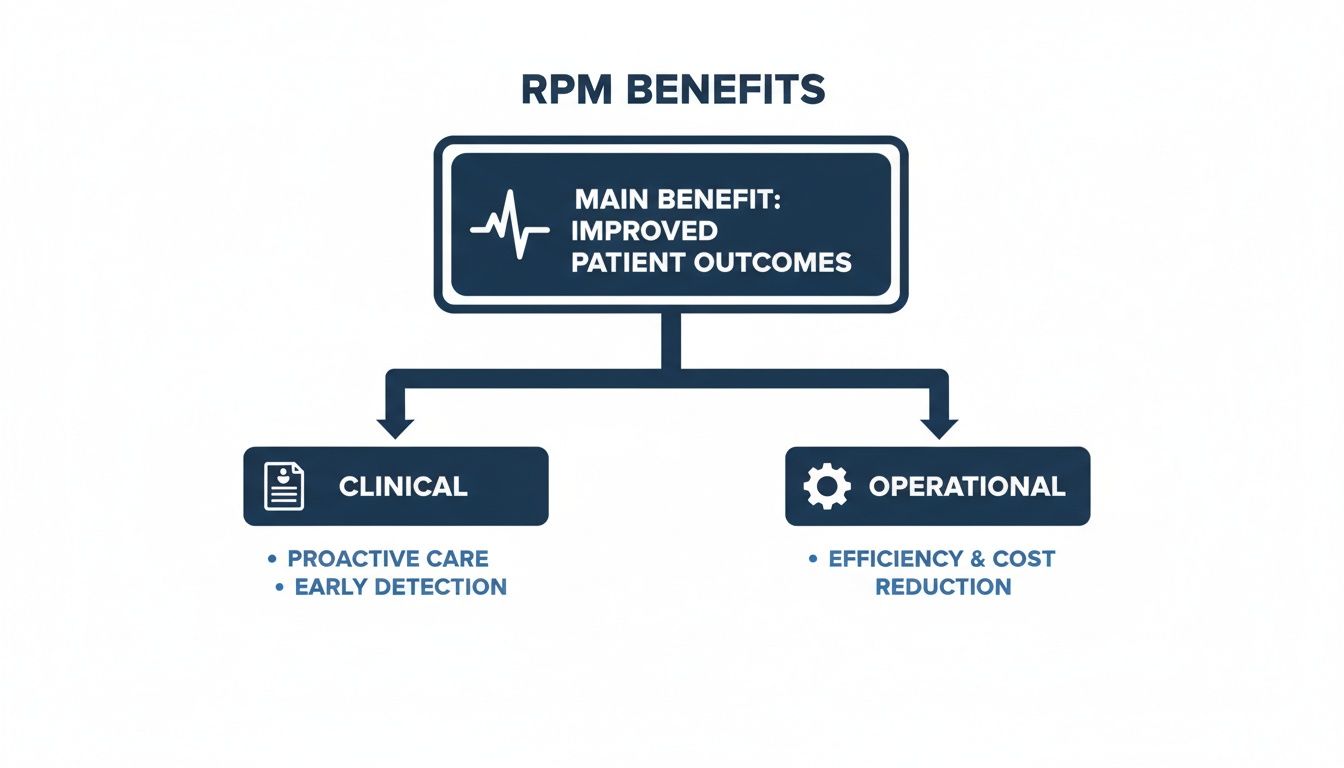
It’s a good reminder that every technical component here has one of two goals: improve patient health or make healthcare delivery more efficient.
Layer 3: The Cloud Platform
After its secure journey, the data arrives at the cloud platform. This is the system’s central command and brain. Raw numbers from countless devices pour in, and this is where they get received, stored, and organized into something meaningful.
The cloud platform handles a few critical jobs:
-
Securely storing huge volumes of patient data, all while staying compliant with strict regulations like HIPAA.
-
Normalizing the data, which means taking information from many different devices and putting it into a consistent, standard format.
-
Applying clinical rules and algorithms to automatically flag any readings that are outside a patient’s normal range.
This is the engine room where the heavy lifting happens, turning a constant stream of individual data points into structured, actionable information.
Layer 4: The Clinician-Facing Application
The final leg of the race ends on the clinician’s computer screen. This is the application layer, which could be a dedicated web dashboard or, ideally, something integrated directly into the practice’s Electronic Health Record (EHR) system. It takes all that processed data and presents it in a way that’s easy to understand and act on.
A clunky, confusing interface is the enemy here; the goal is to prevent burnout, not cause it.
This is where everything comes together. A well-built application gives care teams a clear, at-a-glance view of their entire patient panel, instantly highlighting who needs a phone call and revealing health trends over time. This is where expertise in custom software development becomes so important; it’s about building a tool that truly helps clinicians, rather than burying them in data.
Supercharging RPM with AI and Predictive Analytics
A constant stream of patient data is a double-edged sword. On one hand, it gives you an unprecedented view into a patient’s daily health. On the other hand, it can easily create a ‘data deluge’ – an overwhelming flood of numbers that buries clinicians and leads to serious alert fatigue.
This is exactly where artificial intelligence steps in, turning that raw data into life-saving intelligence. AI transforms remote patient monitoring solutions from simple data collection tools into proactive care engines. It acts as an intelligent filter, sifting through thousands of data points to find the signals that actually matter.
Instead of just showing a clinician every single blood pressure reading, an AI-powered system can spot subtle, multi-day trends that hint at a developing issue. This intelligent layer is what unlocks the true potential of patient monitoring and the real value of AI for your business.

From Reactive Alerts to Predictive Insights
A standard RPM system is pretty good at setting simple thresholds. For example, it can alert a nurse if a patient’s systolic blood pressure spikes above 160 mmHg. This is certainly helpful, but it’s still reactive – the problem has already occurred.
Predictive analytics, fueled by machine learning, takes a massive leap forward. It looks for complex patterns that come before a crisis.
An AI model can analyze a patient’s heart rate, weight, oxygen saturation, and activity levels all at once. By learning from historical data, it can predict the likelihood of a congestive heart failure event days before the patient even feels symptoms. This allows for early, low-cost interventions that can prevent a costly hospitalization.
This predictive power is a huge reason the RPM market is exploding. Valued at $22.03 billion in 2024, the market is on track to hit $110.71 billion by 2033. A key driver is how effective it is in managing chronic diseases like diabetes, which affects 537 million adults globally.
In fact, studies have shown that AI-enhanced RPM can slash hospitalizations by up to 38% in heart failure cases by predicting deterioration up to 48 hours in advance.
Key AI Applications in RPM
The ways AI can be applied to remote patient monitoring go far beyond simple alerts. The real value comes from building models tailored to specific clinical needs with expert AI development services.
Here are some of the most impactful use cases:
-
Personalized Baselines and Thresholds: AI can learn what’s “normal” for each individual. Instead of a one-size-fits-all threshold, the system creates a dynamic baseline that changes with the patient, leading to more accurate alerts and fewer false alarms.
-
Medication Adherence Monitoring: By analyzing data from smart pill dispensers or patient logs, AI can flag when someone is becoming inconsistent with their medication. It can then trigger automated reminders or notify a care coordinator to check in.
-
Risk Stratification: Machine learning algorithms can automatically sort patients into high, medium, or low-risk groups based on their incoming data. This helps clinical teams focus their limited time on the patients who need it most.
-
Behavioral Pattern Recognition: AI can analyze data from activity trackers and patient surveys to spot changes in sleep, mobility, or mood. These subtle shifts can correlate with a decline in health, giving care teams a much more holistic view of a patient’s well-being.
Building these intelligent systems requires real expertise in both healthcare data and machine learning. To get a better sense of the practical steps involved, check out our guide on implementing healthcare analytics.
Ultimately, adding this layer of intelligence ensures that remote patient monitoring solutions don’t just create more data; they deliver clear, actionable wisdom that empowers clinicians and saves lives.
A Practical Guide to Implementation and Compliance
Getting a remote patient monitoring program off the ground is about much more than just the tech. It’s about having a smart, step-by-step plan and being absolutely relentless about security and compliance. Every stage, from the initial idea to a full-scale rollout, needs to be handled with care. This means thoughtful planning, picking the right partners, and building trust with patients by proving you can protect their data.
The stakes couldn’t be higher. We’re talking about sensitive patient health information, and in places like North America, which commands a massive 41.2% of the global RPM market, the pressure to deliver secure health tech is immense. This isn’t just a trend; it’s driven by government support and the hard reality that over 60% of U.S. adults are managing at least one chronic illness.
Because of this, regulations like HIPAA aren’t just a box to tick; they’re the bedrock of your entire operation. You can get a better sense of the dominant role of North America in the RPM market to see just how big this responsibility is.
The Implementation Roadmap
Trying to launch everything at once is a recipe for disaster. A phased rollout is the way to go, as it keeps risks low and helps you build a program that actually works. Jumping the gun can lead to technical headaches, frustrated users, and serious compliance breaches.
Here’s a proven four-step path to follow:
-
Strategy and Vendor Selection: Start with your “why.” Are you aiming to cut down hospital readmissions for heart failure patients? Or maybe improve how well diabetic patients stick to their medication? Once you know your goals, you can find a technology partner who gets what you’re trying to do. Look for a track record of success in real-world client cases.
-
Pilot Program: Think small to win big. A controlled pilot lets you test the technology, iron out the kinks in your clinical workflows, and get priceless feedback from patients and staff without betting the farm.
-
System Integration: This is where the magic and the technical heavy lifting happen. Your RPM platform has to talk to your existing Electronic Health Record (EHR) system. If it doesn’t, data gets siloed, and clinicians won’t have the complete picture they need to make good decisions.
-
Scaled Rollout and Training: Once the pilot proves successful, you can start expanding to more patients. Don’t skimp on training. Your clinical team needs to feel confident using the system, and patients need a simple, clear onboarding process to get them started on the right foot.
Navigating Security and Compliance
Security can’t be an add-on. It has to be baked into your RPM program from the very beginning. Protecting patient health information (PHI) isn’t just a legal obligation; it’s your ethical duty.
When you’re deploying any RPM solution, you have to live and breathe regulations like HIPAA. Getting a firm grip on what compliance entails, including the potential audit costs, is a must. For a closer look at the financial side, this resource on Understanding Your HIPAA Compliance Audit Cost is incredibly useful.
The heart of compliance comes down to three things: data encryption, secure access controls, and clear patient consent. Every bit of data, whether it’s sitting on a server or flying through the air from a patient’s device, must be locked down with encryption.
On top of that, you need to control who sees what. Role-based permissions are key, making sure only the right people can access specific patient information. For a deeper dive into these security protocols, our guide on HIPAA-compliant software development is a great place to start.
This is exactly where a seasoned technology partner proves their worth; they can navigate the maze of regulations for you, delivering a secure system that scales and always puts patient safety first.
Measuring the ROI of Your RPM Program
So, you’re considering launching a remote patient monitoring program. It’s a big step and a significant investment. To get buy-in from stakeholders and prove its worth down the line, you need to think about success in concrete terms. We can’t just rely on feel-good stories; we need a clear, data-driven way to measure its impact.
The best way to do this is to focus on specific Key Performance Indicators (KPIs) that tell the whole story of your Return on Investment (ROI).
A well-run RPM program creates value in several different ways at once. To capture the full picture, we need to look at its impact from three angles: how it helps patients, how it helps your staff, and how it helps the bottom line.
Defining Your Key Performance Indicators
To make a strong business case, you have to track metrics that actually mean something to everyone involved, from the nurses on the floor to the executives in the C-suite. Grouping your KPIs helps you tell a more compelling story about how your remote patient monitoring solutions are making a real difference.
Clinical KPIs (Patient Health Outcomes)
This is the heart of it all. These metrics show that the technology is genuinely making patients healthier, which is why we’re all here in the first place.
-
Fewer Hospital Readmissions: Keep a close eye on your 30, 60, and 90-day readmission rates for chronic conditions like congestive heart failure or COPD. When that number drops, you know you’re doing something right.
-
Better Biometric Control: Are your diabetic patients’ A1c levels improving? Are you seeing lower average blood pressure for those with hypertension? These are tangible signs of progress.
-
Patient Adherence and Engagement: It’s simple – are patients actually using the devices? Tracking how consistently they take readings tells you a lot. High engagement almost always leads to better health outcomes.
At the end of the day, you need to prove that keeping a constant watch on patients leads to quicker interventions and better day-to-day disease management. These clinical wins are what drive all the other benefits.
Operational KPIs (Workflow Efficiency)
These indicators show how RPM helps your team get more done without burning out. It’s about working smarter.
-
Patients Managed Per Clinician: A good RPM platform should empower a single care manager to effectively look after a much larger group of patients without compromising care quality.
-
Fewer Emergency Room (ER) Visits: Catching a problem early with an alert from an RPM device often means you can prevent it from spiraling into a full-blown emergency.
-
Less Administrative Drag: Think about all the time saved when data is collected automatically instead of through endless phone calls and manual data entry. That time adds up.
Financial KPIs (The Bottom Line)
This is where the investment really pays off in black and white.
-
Revenue from New Billing Codes: This is a direct financial win. Track the income you’re bringing in from the specific CPT codes for RPM services.
-
Cost Savings from Averted Hospitalizations: Every readmission or ER visit you prevent has a significant dollar amount attached to it. Calculate it.
-
Lower Overall Cost of Care: The long-term goal is to show a clear reduction in the total cost of managing a patient’s chronic illness over their lifetime.
When you track these KPIs together, you can build a powerful, evidence-based story. You can walk into a meeting and say that a 15% reduction in readmissions not only improved patient lives but also directly saved the hospital hundreds of thousands of dollars.
An experienced AI solutions partner can help you design and build systems that make tracking these metrics feel effortless, turning a flood of raw data into a clear picture of your program’s success.
Your Top RPM Questions, Answered
As you start to think about bringing remote patient monitoring into your practice, you’re bound to have some questions. It’s only natural. Getting straight answers is the first step toward building a program that truly helps your patients and supports your clinical team.
Let’s dive into some of the most common questions we hear about RPM implementation, security, and the financial side of things.
What are the biggest challenges in implementing RPM?
Interestingly, the toughest hurdles are rarely about the technology itself; they’re about people and processes. Getting an RPM system to talk to your existing Electronic Health Record (EHR) system can be a puzzle, and it requires a solid plan to make sure data flows smoothly without creating extra work. Another big piece is patient engagement. The best system in the world is useless if patients don’t consistently use their devices, so making it easy and motivating for them is key. And what about your clinicians? You have to be careful to avoid overwhelming them with a constant stream of data. The goal is to reduce their workload, not add to it. A successful launch depends on smart change management, software that’s genuinely easy for everyone to use, and systems that can intelligently flag what actually needs a clinician’s attention. This is exactly where an experienced AI solutions partner can design workflows that empower your staff instead of burning them out.
How is patient data kept secure?
Security isn’t just a feature; it’s the bedrock of any trustworthy RPM program. Every single component of a remote patient monitoring solution must be fully HIPAA compliant, no exceptions. We achieve this with a multi-layered defense. Think of it like a digital fortress. Security is built in from the ground up with end-to-end data encryption, strict user authentication, and access controls that ensure people only see what they’re supposed to. We also conduct regular security audits and rely on secure cloud infrastructure. Every byte of data is protected, from the moment it leaves the patient’s device to when it appears on the clinician’s screen. Working with a developer who lives and breathes compliant healthcare software development is non-negotiable. It’s the only way to minimize risk and earn the trust of your patients.
How do providers get reimbursed for RPM?
This is a great question because it gets to the financial sustainability of the program. In the United States, the Centers for Medicare & Medicaid Services (CMS) has established specific CPT codes that allow you to bill for RPM services. This makes it a viable care model, not just a clinical nice-to-have. These codes typically cover essential activities like the initial setup and patient education on how to use the devices, providing the monitoring devices themselves, and the time your clinical staff spends each month reviewing and interpreting the patient data. Many private insurers are following suit with their own reimbursement policies, though the details can differ. Getting a firm handle on these billing codes from the start is fundamental to designing an RPM program that delivers both better health outcomes and a strong return on investment.
Ready to build a secure, intelligent, and scalable remote patient monitoring solution? Bridge Global combines deep expertise in AI and compliant healthcare technology to turn your vision into reality. Let’s create a system that improves patient outcomes and streamlines your clinical workflow. Explore our custom software development services to get started.

About Preethi Saro Philip
Preethi Saro Philip is a Post Graduate Research Degree holder in Economics with more than 10 years of experience in writing, editing, research and teaching. She has an intense passion for content crafting and calls herself a ‘wordsmith’. She enjoys writing on wide-ranging topics including business, technology, health & lifestyle, education, environment etc.
View all posts by Preethi Saro Philip →